Where to build an IT team in Europe: look beyond salaries
Salary alone won’t tell you where to build an IT team in Europe. Talent depth, hiring competition and office availability can change the decision.

I have set up and scaled service centres in locations like Bangalore and Lisbon, the Lisbon one during COVID. Salary is naturally one of the first questions and the right benchmark depends on the roles and seniority you are hiring, not a generic average. But when you compare cities side by side, salaries are rarely where you see the biggest differences. Talent depth and how hard it is to attract the right people usually shape the decision more than people expect. Office availability is also something that needs to be taken into consideration.
Why these cities keep coming up
Central Europe and Iberia are on most shortlists for companies building teams abroad, especially for companies headquartered in Europe. Poland has a particularly large business-services sector.
Poland's business service centres employed about 488,700 people at the end of Q1 2025, up 6.2% in a year. Kraków alone accounts for nearly 108,000 of them, across 312 centres. Of the new centres opened between January 2024 and March 2025, 42.6% were IT. (ABSL, Business Services Sector in Poland 2025)
In Czechia, the sector is expected to reach about 214,000 jobs in 2026 across 380 centres, and more than 40% of the people working in them are foreigners. (ABSL Czech Republic, via Expats.cz, March 2026)
Portugal is smaller, with around 30,000 people in shared-service centres, but most of that has been built since 2015. (AICEP Portugal Global)
Salaries: closer than you'd expect
If you line up published 2025–26 salary guides for software engineers, Warsaw, Kraków, Wrocław, Katowice and Prague sit within a few percent of each other. Barcelona, Lisbon and Porto come in lower, roughly 15–25% below Warsaw.
That gap is real, but it's smaller than the cost conversations I usually hear. And salary guides differ in seniority levels and timing, so I wouldn’t choose a city based on a 10% difference between salary guides alone.
Offices: a smaller cost, but strategically important
Office rent is a much smaller part of the operational cost than salaries. But it's where the cities differ most. In Kraków, Wrocław and Katowice, office rents run at roughly half of central Warsaw. In Portugal, Porto comes in about a third below Lisbon.
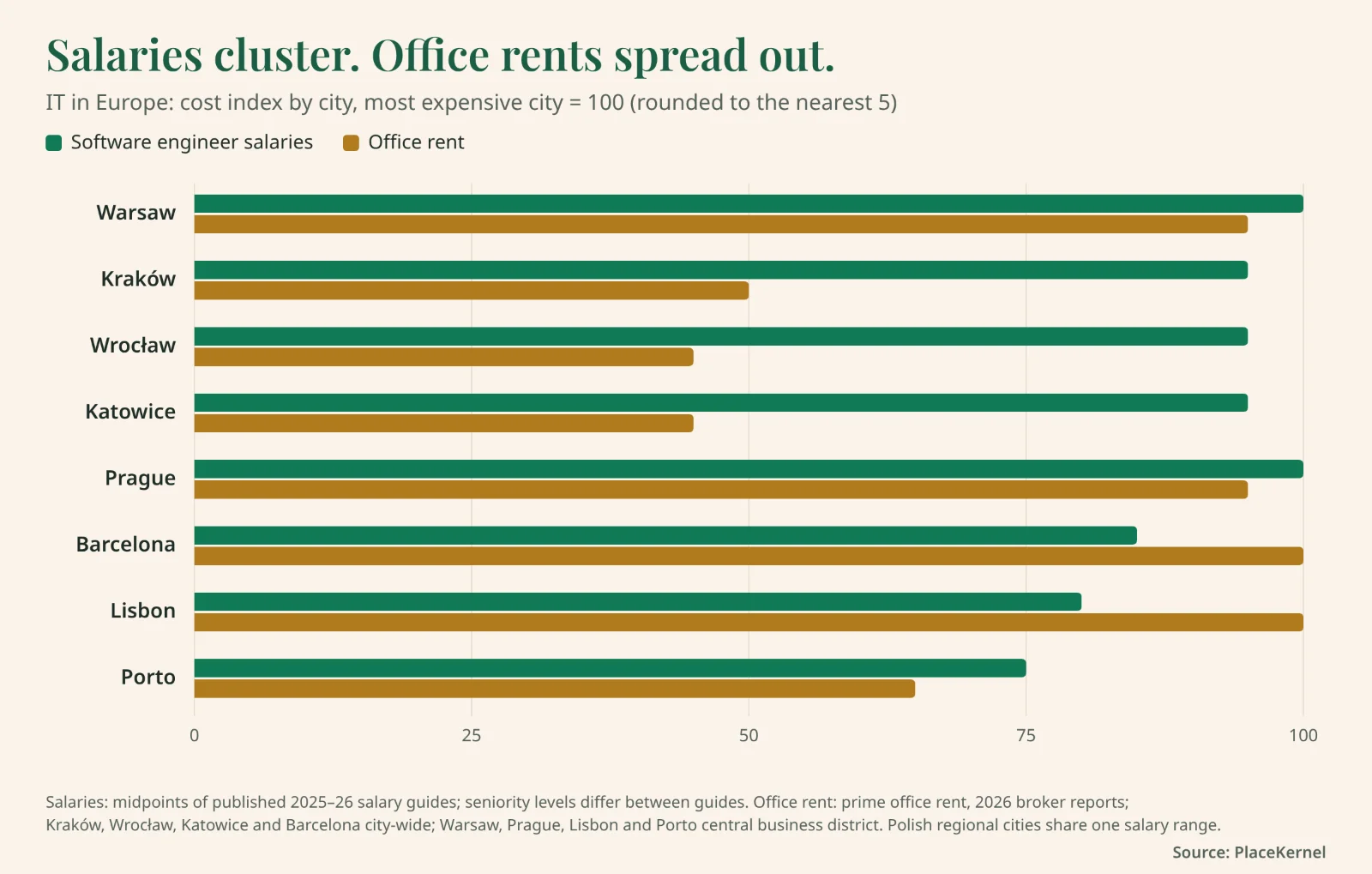
Price isn't the only issue. In Lisbon, office vacancy was very low when we were looking. Several companies were often negotiating for the same space, especially in the business parks. If you found something that worked, you had to decide quickly and commit. Waiting a few weeks to compare options usually meant losing the space. If you're planning for Lisbon, build that into your timeline. Check suitable space early rather than treating it as something to resolve after choosing the city.
The office also matters for hiring. Even with hybrid and remote work, employees want a nice space to come to when they do go in, and candidates notice the difference. A welcoming workplace, good amenities and a straightforward commute are part of your offer alongside salary and benefits. Cheap rent can be a false saving if the location makes hiring harder, so when you compare office options, look at more than the price per square metre.
Talent: the cheapest city isn't always the easiest to hire in
Of the European cities we track, Warsaw, Kraków and Barcelona have the deepest IT talent pools. The others are a step behind. That doesn't make them bad choices, but it changes how hard you'll have to work to fill roles, and how long it takes.
A deep pool also means more competition. You're not hiring from an empty market; you're hiring people who already work somewhere else. That's a bigger topic, and I'll come back to it in a separate article.
English won't decide it for you
In my experience, English is rarely the deciding factor when choosing locations in countries like Poland, Czechia, Portugal, Spain and Romania for an IT team. You'll find English-speaking talent in all of them. What matters is whether candidates can communicate effectively in the roles you’re hiring for, especially when working with international colleagues or customers.
So which one?
It depends on what you're building. If you need a large IT team quickly, the depth of the talent pool matters more than a few percent on salary. If you're building a smaller team and cost matters most, a regional city with lower office costs can make more sense. And if stability or specific skills matter, the picture shifts again.
That's what PlaceKernel's reports work out: which city fits your team, based on the Function you're building and what matters most to you, with the sources behind every key figure.
Find the right location for your team →
Sources
Related articles
- India or Europe: where should your next team be?
India offers scale and lower costs. Europe offers closer collaboration with a European HQ. The right choice depends on your roles and how the team will work.
- Where to build a Finance team in Europe: rethink the costs
For Finance, salaries differ far more between European cities than for IT. Cost assumptions don't always hold, and offices and notice periods also play a part.